pdfnestguide
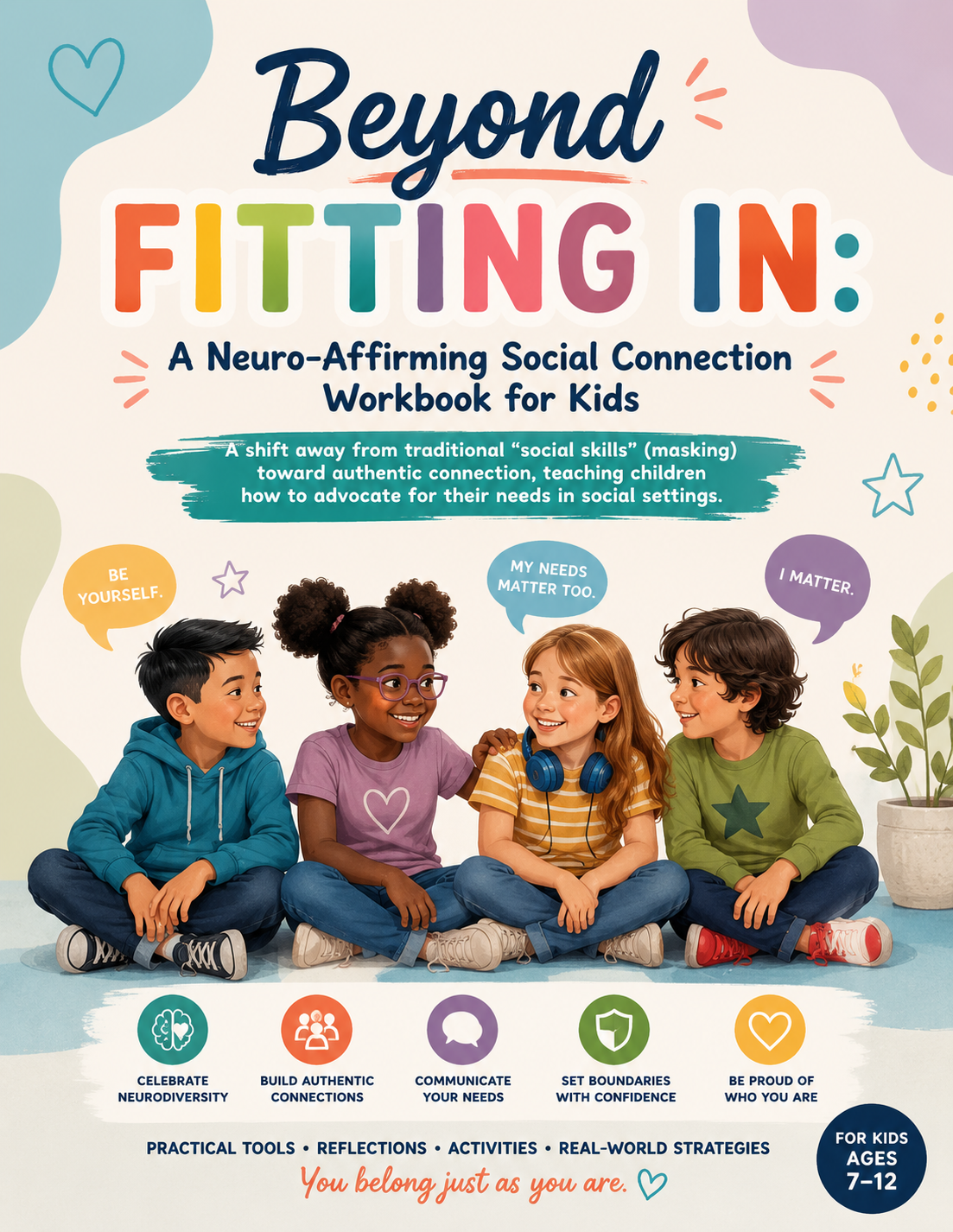
Beyond Fitting: A Neuro Affirming Social Connection Workbook for Kids
Beyond Fitting: A Neuro Affirming Social Connection Workbook for Kids
Couldn't load pickup availability
Beyond Fitting In
A Neuro-Affirming Social Connection Workbook for Kids
Help children build authentic relationships, communicate their needs, and feel proud of who they are—without teaching them to mask.
Many traditional “social skills” programs focus on helping autistic children appear more neurotypical. They may reward eye contact, scripted conversations, quiet hands, or behavior that looks socially appropriate from the outside—even when maintaining that behavior is exhausting for the child.
Beyond Fitting In offers a different approach.
This 46-page digital guide and workbook helps parents, caregivers, educators, and school professionals support autistic children in developing meaningful connections without asking them to hide the traits that make them who they are.
Instead of teaching children how to perform friendship, the workbook focuses on self-advocacy, co-regulation, communication, boundaries, shared interests, and relationships in which a child feels safe enough to be recognizably themselves.
The goal is not to help children fit into every group.
The goal is to help them find relationships where they genuinely belong.
Who this workbook is for
Beyond Fitting In was created for:
-
Parents and caregivers of autistic children
-
Grandparents and foster caregivers
-
Teachers and paraeducators
-
School counselors and support teams
-
Speech-language pathologists
-
Occupational therapists
-
Neurodiversity-affirming professionals
-
Families looking for alternatives to compliance-based social-skills training
The workbook is designed primarily for children ages 7–12, with many concepts and activities also adaptable for school-aged children approximately 5–14, depending on their communication style, reading level, and support needs.
Most activities are designed to be completed collaboratively with a trusted adult.
This workbook may help if your child:
-
Comes home exhausted after trying to fit in socially
-
Has difficulty explaining sensory, emotional, or communication needs
-
Connects through interests rather than traditional conversation
-
Prefers parallel play or smaller social settings
-
Has one or two meaningful relationships instead of a large friend group
-
Struggles to recognize when their social battery is depleted
-
Needs help asking for space, clarification, or a break
-
Has experienced rejection, exclusion, or bullying
-
Feels pressure to make eye contact or suppress natural movement
-
Has been described as “attention-seeking,” “rude,” or “uncooperative” when overwhelmed
-
Needs practical language for communicating with peers and adults
-
Wants connection but does not want to perform a different personality to receive it
What children can learn
With supportive adult guidance, children can use this workbook to:
-
Recognize their personal communication style
-
Understand that different social styles are valid
-
Identify what safe and authentic friendship feels like
-
Notice when their social battery is becoming depleted
-
Communicate sensory and emotional needs
-
Ask for repetition, clarification, space, or a break
-
Practice self-advocacy phrases
-
Set boundaries respectfully
-
Connect with others through shared interests
-
Reflect on social experiences without being judged
-
Recover after rejection or a difficult interaction
-
Recognize the difference between ordinary conflict and bullying
-
Develop pride in their identity
-
Build relationships without hiding who they are
What adults will learn
Parents, caregivers, and educators will learn how to:
-
Replace “fitting in” with authentic connection as the goal
-
Recognize interest-based, parallel, and low-demand forms of connection
-
Understand the emotional and cognitive cost of masking
-
Co-regulate before attempting to teach a social skill
-
Give children practical self-advocacy language
-
Help children identify compatible friends and communities
-
Partner more effectively with schools
-
Request observable and measurable accommodations
-
Respond thoughtfully to rejection, conflict, and bullying
-
Avoid common mistakes made by well-meaning adults
-
Support a child without overcorrecting their natural behavior
What is inside the workbook
Introduction: Welcome, and Why This Guide Exists
Understand who the workbook is for, what it teaches, and how to use it without turning the activities into another demand.
Part One: Understanding the Real Goal
Chapter 1: Why “Fitting In” Is the Wrong Goal
Explore how traditional social-skills programs can teach performance instead of connection—and why appearing comfortable is not the same as feeling safe.
Chapter 2: Learning Your Child’s Social Language
Learn to recognize forms of connection that may not look conventional, including shared interests, parallel activities, information sharing, and low-pressure companionship.
Chapter 3: The Masking Trap
Understand what masking can look like, why children may use it, and how to help without forcing or abruptly removing a coping strategy.
Part Two: Building the Real Foundation
Chapter 4: Co-Regulation Before Social Skills
Learn why a regulated nervous system creates the foundation for communication, problem-solving, and learning.
Chapter 5: Teaching Self-Advocacy—Giving Kids the Words
Help children develop short, usable phrases for communicating sensory needs, asking for clarification, requesting a pause, and setting boundaries.
Chapter 6: Finding “Their People”
Focus on compatibility rather than popularity. Learn how shared interests, accepting environments, and low-pressure opportunities can support genuine friendship.
Part Three: Taking It into the World
Chapter 7: Partnering with Schools without Going to War
Use clear, observable language when communicating with teachers and school teams. The chapter includes practical guidance for IEP and 504 discussions.
Chapter 8: Rejection, Bullying, and Repair
Help children process painful social experiences while distinguishing between ordinary disagreement, mismatch, and repeated bullying.
Reusable tools and worksheets
The workbook includes practical pages families and professionals can print and reuse.
The Social Battery Tracker
Help children notice patterns in their social energy, including:
-
Morning energy
-
Afternoon energy
-
Evening energy
-
Helpful and draining situations
-
Sensory demands
-
Transitions
-
Unexpected changes
-
Signs of overload
-
Recovery needs
The Self-Advocacy Script Builder
Create short phrases for moments when a child needs:
-
Less sensory input
-
A break or pause
-
Repetition or clarification
-
More personal space
-
Movement
-
A trusted adult’s help
The Interest-Bridge Map
Use a child’s interests as a genuine pathway toward compatible people, activities, and communities.
IEP and 504 Language Cheat Sheet
Translate vague or judgmental descriptions into specific, observable, and support-focused school language.
The Friendship Debrief Journal Page
Reflect on a social interaction without grading the child’s performance. Prompts focus on what happened, how it felt, what the child needed, and what support may help next time.
The 30-Day Gentle Start Challenge
Introduce one small, sustainable step at a time through four stages:
-
Observe
-
Build language
-
Expand the child’s world
-
Advocate
The 90-Day Roadmap
Continue using the workbook through three practical phases:
-
Foundation
-
Practice and advocacy
-
Consolidation and extension
Additional resources included
-
Action plans
-
Adult reflection questions
-
Child-centered checklists
-
Real-world examples
-
Key takeaways
-
Common mistakes made by well-meaning parents
-
Frequently asked questions
-
Neurodiversity-affirming glossary
-
Guidance for finding additional resources
-
Final letter to parents and caregivers
Why this workbook is different
Beyond Fitting In does not measure social success by eye contact, popularity, stillness, scripted greetings, or how neurotypical a child appears.
It centers:
-
Authentic communication
-
Emotional and sensory safety
-
Self-advocacy
-
Co-regulation
-
Mutual understanding
-
Compatible relationships
-
Respect for different communication styles
-
The child’s right to set boundaries
-
Connection without performance
The workbook recognizes that communication differences are relational. Autistic and non-autistic people may have difficulty interpreting one another, and responsibility for understanding should not be placed entirely on the autistic child.
A neuro-affirming approach
This resource does not teach children to suppress harmless autistic traits or imitate neurotypical behavior to gain acceptance.
It supports children in understanding themselves, communicating their needs, navigating relationships, and recognizing environments where they can participate without hiding who they are.
The workbook may introduce ideas that differ from compliance-based programs. Families are encouraged to use professional judgment, listen to autistic perspectives, and include the child’s preferences whenever possible.
Product details
-
Product type: Digital PDF guide and workbook
-
Length: 46 professionally designed pages
-
Format: PDF
-
Recommended audience: Children ages 7–12 with adult support
-
Adaptable range: Approximately ages 5–14
-
For: Parents, caregivers, educators, and support professionals
-
Delivery: Instant digital download
-
Use: Read digitally or print reusable worksheets
-
Language: English
-
Physical delivery: No physical product will be shipped
How to use the workbook
-
Download the PDF after completing your purchase.
-
Read Part One before beginning the activities.
-
Choose the chapter that best matches your child’s current needs.
-
Complete activities collaboratively and without pressure.
-
Let your child skip questions or pause when needed.
-
Print and reuse the worksheets as circumstances change.
-
Share relevant pages with teachers or other trusted professionals.
-
Follow the 30-day challenge or 90-day roadmap at a pace that works for your family.
This workbook is not designed to become another demand. Use what helps, adapt what needs changing, and pause whenever your child needs space.
Important information
Beyond Fitting In is an educational resource. It is not a diagnostic tool or a substitute for individualized medical, psychological, speech-language, occupational-therapy, mental-health, or educational services.
Every autistic child is different. A strategy that helps one child may not be appropriate for another. Parents and caregivers should make decisions in partnership with qualified professionals they trust and, whenever possible, with input from the child.
If a child is experiencing thoughts of self-harm, severe school refusal, abuse, or a mental-health crisis, contact a qualified mental-health professional, emergency service, or crisis resource in your location. This workbook is not designed for crisis situations.
Because this is a digital product, no physical item will be mailed. The purchaser may print the designated reusable worksheets for personal, in-home, or single-classroom use. Sharing, reselling, or redistributing the complete workbook is not permitted.
Children deserve more than acceptance earned through performance
A child should not have to become less recognizable to be included.
They deserve relationships where their communication is respected, their boundaries matter, and their natural way of connecting is understood.
Your child does not need to fit everywhere. They need places where they can belong as themselves.
Share