

The Couples Money Date System: Budget Spreadsheet + 15-Page Guide
Couldn't load pickup availability
Most couples don't fight about money. They fight about what the money means.
Who's carrying more. Who spent what without saying. Whether "we split everything" is actually fair when one of you earns twice as much. Whether asking is checking in — or checking up.
This system is built for the version of togetherness most couples actually live: shared bills, separate accounts, different incomes, and a real need to stop guessing.
The tab that makes this different
Every couple's budget template shows you what you spent. This one tells you who owes whom.
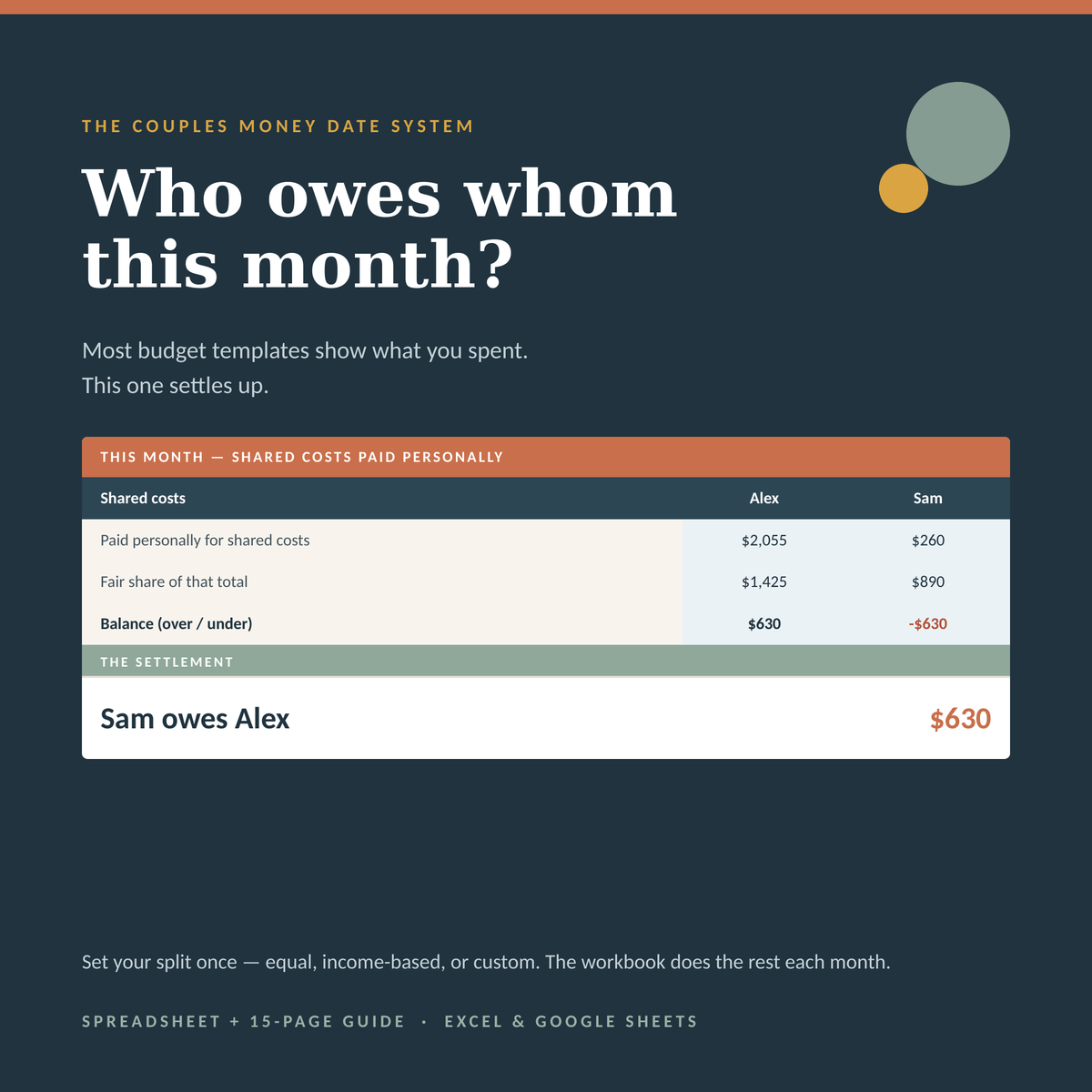
The Settle Up tab tracks what each partner actually paid toward shared costs from their own money, compares it against your agreed split, and gives you one sentence:
Sam owes Alex — $630
No spreadsheets on the side. No arguing from memory. No one quietly keeping score.
It shows the month and the year-to-date, so you can settle monthly or let it ride and clear it quarterly. And if the same person is short every single month, you'll see it — which usually means the split needs changing, not the person.
What you get
A spreadsheet with 11 working tabs — not a pretty grid you have to build yourself:
- Fair Split — compare equal, income-based, or custom contribution rules, and see what each option costs each partner as a share of their own income
- Settle Up — the monthly and year-to-date reconciliation
- Dashboard — monthly totals, 12-month cash flow chart, spending by category
- Budget vs Actual — set a target per category, see On track / Close to limit / Over by $60
- Transactions & Bills — dropdown-driven entry, per-bill split overrides
- Savings Goals — progress bars and automatic target dates
- Debt Plan — payoff estimates that tell you honestly when a payment is too small to cover the interest
- Money Date — the monthly conversation, structured
A 15-page guide that handles the part spreadsheets can't:
- The 25-minute Money Date agenda — arrive, notice, decide, assign, close. Timed, because open-ended money talks go badly.
- Conversation scripts — what to say instead of "Why did you spend that much?" and "I pay for everything."
- Financial boundaries — what's genuinely shared, what stays personal, and how to set a purchase-discussion threshold
- Troubleshooting — for when one partner does all the tracking, or you start avoiding the money date entirely
Built for real households
Works in Excel or Google Sheets. Nothing to connect, no bank login, no subscription — your numbers stay in your own file.
Set up in about ten minutes. Yellow cells are yours to fill; blue cells calculate themselves.
Use it if you have different incomes and 50/50 has quietly stopped feeling fair. If you keep separate accounts and want shared clarity without merging everything. If one of you carries debt the other didn't create. If you're moving in together, engaged, or newly married and want to set the pattern before resentment sets it for you.
A note on what this isn't
It isn't surveillance. The guide says so directly, and the workbook is designed around one agreement printed on page two:
We will use this tool to understand our household, not to monitor, embarrass, or control each other.
It also isn't financial advice, and it won't fix a relationship where money is being used as leverage. The guide includes a plain warning about what financial control looks like, because clarity tools should never become the instrument.
Format: Instant download · .xlsx spreadsheet + PDF guide + setup Read Me
Compatible: Microsoft Excel, Google Sheets, Numbers
License: Personal use, one household
Clarity before conflict. Decisions before assumptions.

-
Instant download
Your file is available the moment payment clears — on screen and by email.
-
Read on any device, or print it
A standard PDF. Opens on phone, tablet, laptop or e-reader. Print it if you prefer paper.
-
A real person can help
Trouble with a download? Email us with your order number and we'll sort it.