
James Madison — The Father of the Constitution at War
Couldn't load pickup availability
He designed the machine. Then he had to find out whether it could take a hit.
He was five foot four and barely a hundred pounds — the smallest president in American history, with a voice so soft that clerks leaned in to catch his words. He wrote the Virginia Plan, took the only complete notes of the Constitutional Convention, argued the Constitution into existence in the Federalist Papers, and drafted the Bill of Rights he had originally opposed.
Then he became president, and watched his own creation get stress-tested nearly to destruction.
An invasion of Canada that collapsed on contact. A militia that ran at Bladensburg. The Capitol, the Treasury, and the President's House in flames on the night of August 24, 1814 — while British officers ate the dinner laid for the Madisons before setting fire to the room. A New England convention flirting with secession. A treasury with no money and no national bank.
And through all of it, one fact that decides how historians now judge him: he suspended no writ of habeas corpus, jailed no editors, prosecuted no critics, and held the 1812 election on schedule — an election he could have lost.
The author of the Bill of Rights governed a losing war without breaking his own rules.
What's inside
Ten narrative chapters carrying you from a sickly Princeton student cramming four years into two, to Philadelphia in 1787, to a burning capital and a peace nobody expected:
- Montpelier, 1751 — the frail scholar who won rooms by being the most prepared person in them
- "Toleration" vs. "Free Exercise" — how changing one word created American religious liberty
- Philadelphia, 1787 — the Virginia Plan, the notes, and the proposals he lost
- Federalist 10 and 51 — "If men were angels, no government would be necessary"
- Dolley — the woman who invented the public role of First Lady, and what she really saved in 1814
- The road to war, Tecumseh's confederacy, the burning of Washington, and the Treaty of Ghent
And in every chapter, four tools that turn reading into understanding:
✦ Key Takeaways — the chapter distilled to what you'll remember a year from now
✦ Reflection Questions with space to write — not quiz questions, but the ones historians still argue about
✦ Historical Significance — why this chapter matters to the world you live in
✦ Recommended Reading — where to go deeper, drawn from current scholarship
Plus: master timeline, cabinet roster, election results, glossary, cast of characters, and a closing capstone where you write your own verdict on the man.
Honest history, fairly told
This volume draws on modern scholarship — Feldman, Ketcham, Rakove, Alan Taylor, Hickey, Allgor — and it doesn't look away from what older accounts skip.
Madison enslaved more than a hundred people at Montpelier and freed none, not in life and not in his will. His enslaved valet Paul Jennings, who was at his deathbed, later bought his own freedom and wrote the first White House memoir — and corrected the legend about who actually carried Washington's portrait out of the burning mansion. That story is here, in his words.
The War of 1812 is told as four different wars: America's, Britain's, Canada's, and — most consequentially — the war that ended the last realistic chance for an independent Native power in the continent's interior. Tecumseh gets a chapter's worth of weight, not a footnote.
Where historians disagree, this guide says so and hands you the argument.
Designed to be kept
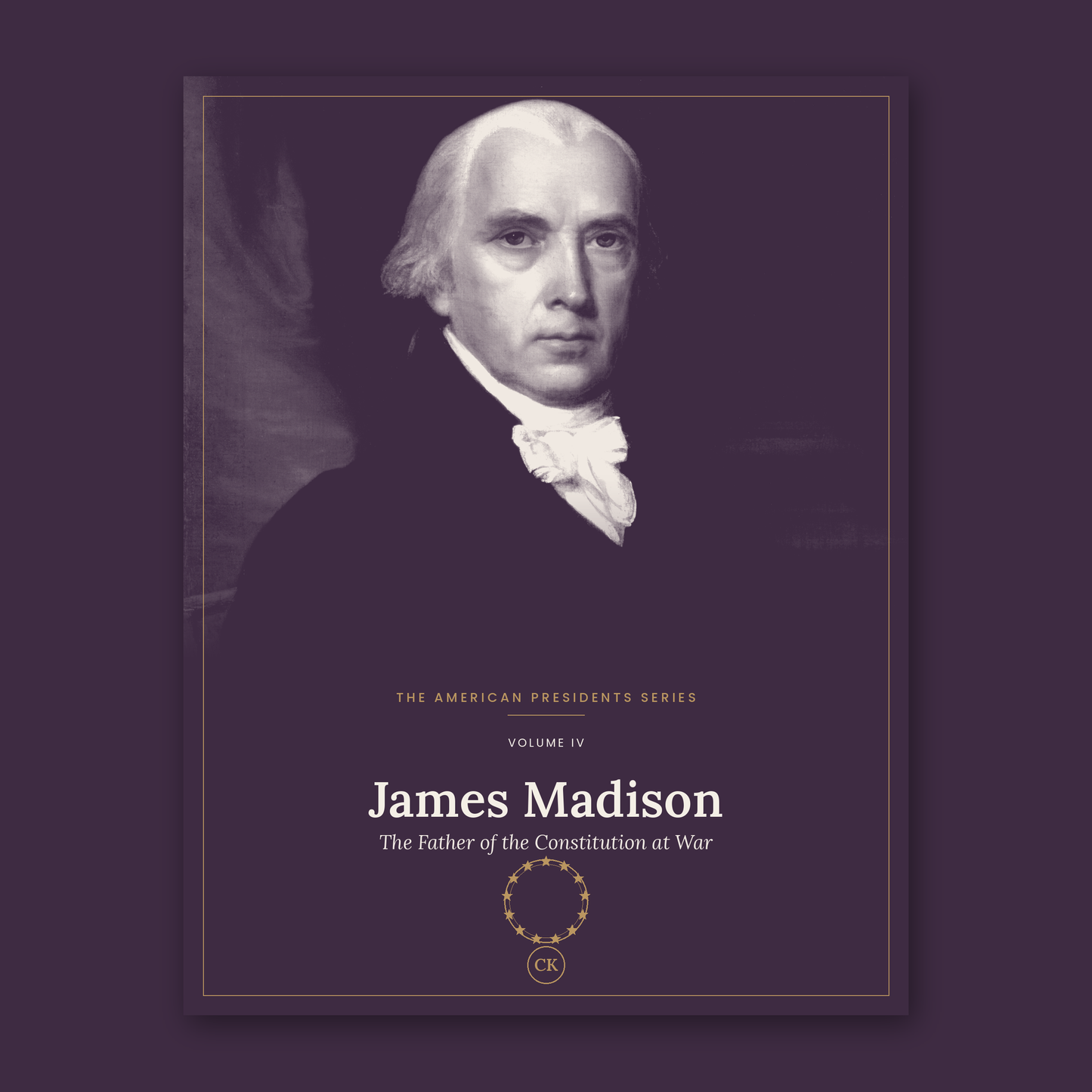
Smoke-gray and silver, with the Vanderlyn presidential portrait rendered in duotone inside a classical arch. Full-page section openers. Clean white pages that print beautifully at home. Set in Times New Roman for comfortable long-form reading.
Not a slideshow in a PDF wrapper — a real book.
Made for: homeschool families · AP US History and college students · teachers who need discussion-ready material · civics and constitutional law readers · leadership readers · anyone who wants to know whether a democracy can survive its worst year
Format: Instant PDF download · 8.5 × 11 in · 43 pages · print-friendly · works on any device
Volume IV of a complete series covering every President of the United States. Also available: Washington, Adams, Jefferson, and Monroe.
-
Instant download
Your file is available the moment payment clears — on screen and by email.
-
Read on any device, or print it
A standard PDF. Opens on phone, tablet, laptop or e-reader. Print it if you prefer paper.
-
A real person can help
Trouble with a download? Email us with your order number and we'll sort it.