
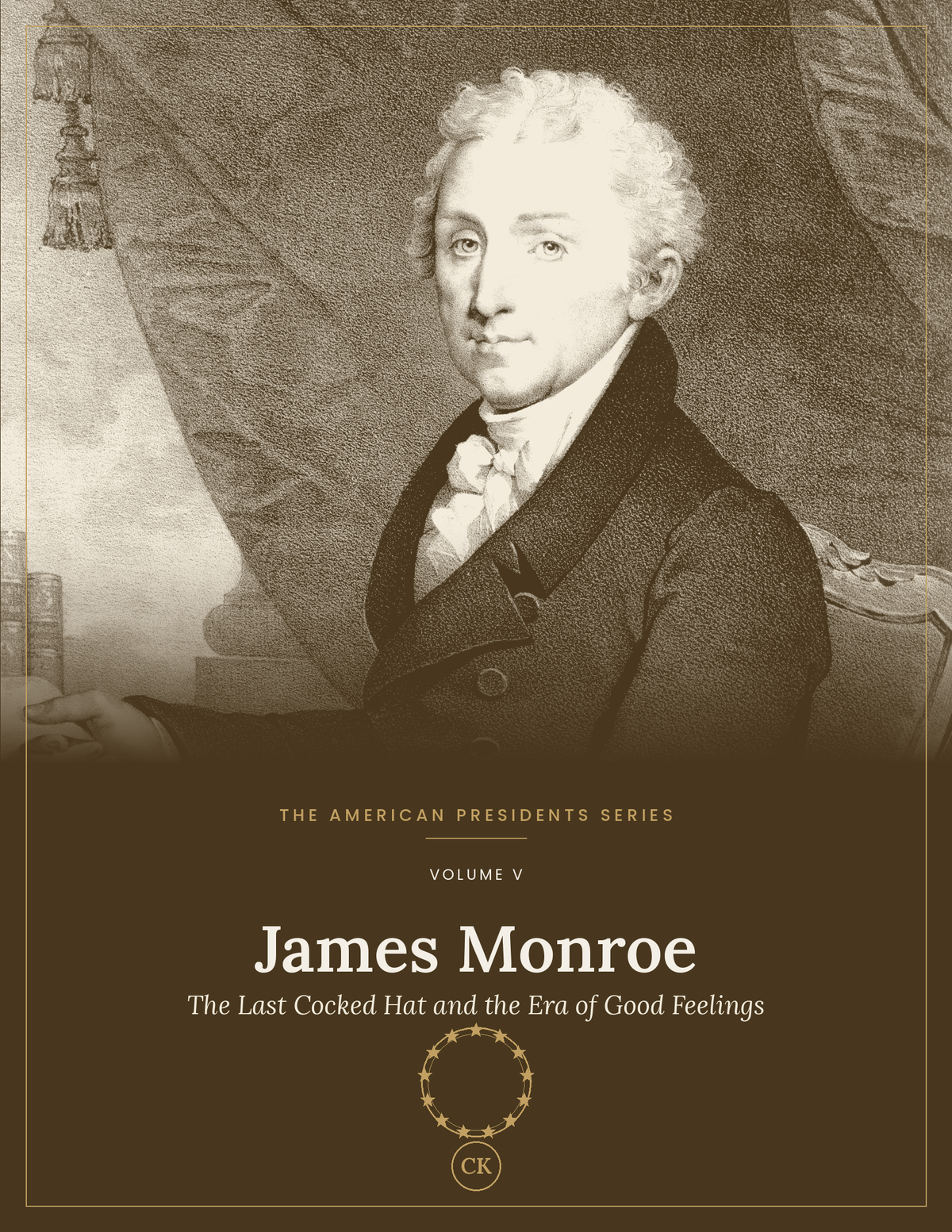
James Monroe — The Last Cocked Hat and the Era of Good Feelings
Couldn't load pickup availability
What happens to a democracy when the opposition party disappears?
America found out between 1817 and 1825, and the answer was not what anyone expected.
James Monroe was the last president to have carried a musket in the Revolution — a nineteen-year-old lieutenant shot through the shoulder at Trenton, an artery severed, alive only because a village doctor had joined the march that morning on impulse. You have seen him without knowing it: he is the young officer steadying the flag behind Washington in the most reproduced painting in American history.
Forty years later he governed a country with no rival party, no European enemy, and a Boston newspaper's flattering label stuck to his presidency: the Era of Good Feelings.
The label was wrong. Underneath it: the republic's first great depression, a general who invaded a foreign country without orders, a constitutional crisis over slavery that Jefferson called a fire bell in the night — and a doctrine that would define American foreign policy for two centuries.
Removing the opposition didn't produce harmony. It produced factions, personal ambition, and an election in 1824 so broken that the House had to decide it. The modern party system was born out of the wreckage.
What's inside
Ten narrative chapters from a fatherless sixteen-year-old raiding the royal governor's arsenal to a bankrupt ex-president dying on the Fourth of July:
- Trenton, 1776 — the wound that nearly killed him, and the painting that made him anonymous
- The Anti-Federalist — the man who voted against the Constitution and became its fifth chief executive
- Paris, London, Madrid — recalled in disgrace, redeemed at Louisiana, wounded when Jefferson buried his treaty
- 1814 — the only person in American history to run the State and War Departments at the same time
- Florida, Jackson, and the Transcontinental Treaty — an unauthorized invasion that produced a claim to the Pacific
- Panic and Missouri — the depression and the compromise that drew a line across the country at 36°30′
- The Monroe Doctrine — a weak nation with a small navy telling Europe to stay out of half the world
And in every chapter, four tools that turn reading into understanding:
✦ Key Takeaways — the chapter distilled to what you'll remember a year from now
✦ Reflection Questions with space to write — the questions historians still argue about
✦ Historical Significance — why this chapter matters to the world you live in
✦ Recommended Reading — where to go deeper, drawn from current scholarship
Plus: master timeline, cabinet roster, election results, glossary, cast of characters, and a closing capstone where you deliver your own verdict — and rank all five presidents in the series.
Honest history, fairly told
Drawing on modern scholarship — McGrath, Unger, Howe, Sexton, Wilentz — this volume refuses the soft focus older accounts gave the period.
The First Seminole War is presented as what it substantially was: a campaign to eliminate Florida as a refuge for people escaping slavery, not merely a border security operation. Monroe's 1825 removal proposal is named for what it became — the blueprint later used for the Trail of Tears, stripped of the voluntary condition he attached. And the slavery record is direct: he enslaved dozens, freed almost none, sold people to cover debts, suppressed Gabriel's Rebellion, and championed a colonization scheme that free Black Americans overwhelmingly rejected as deportation from their own country. Liberia's capital is named Monrovia for him.
The Monroe Doctrine chapter includes how it reads in Bogotá and Managua after the 1904 Roosevelt Corollary turned a shield into a sword — not just how it reads in Washington.
Where historians disagree, this guide says so and hands you the argument.
Designed to be kept
Deep forest green and antique gold, with a period engraving of Monroe rendered in duotone inside a rounded panel. Full-page section openers. Clean white pages that print beautifully at home. Set in Times New Roman for comfortable long-form reading.
Not a slideshow in a PDF wrapper — a real book.
Made for: homeschool families · AP US History and college students · teachers who need discussion-ready material · foreign policy and civics readers · leadership readers · anyone curious what one-party government actually looks like
Format: Instant PDF download · 8.5 × 11 in · 42 pages · print-friendly · works on any device
Volume V completes the founding era. Also available: Washington, Adams, Jefferson, and Madison — or save with the five-volume Founding Era Collection.
-
Instant download
Your file is available the moment payment clears — on screen and by email.
-
Read on any device, or print it
A standard PDF. Opens on phone, tablet, laptop or e-reader. Print it if you prefer paper.
-
A real person can help
Trouble with a download? Email us with your order number and we'll sort it.