
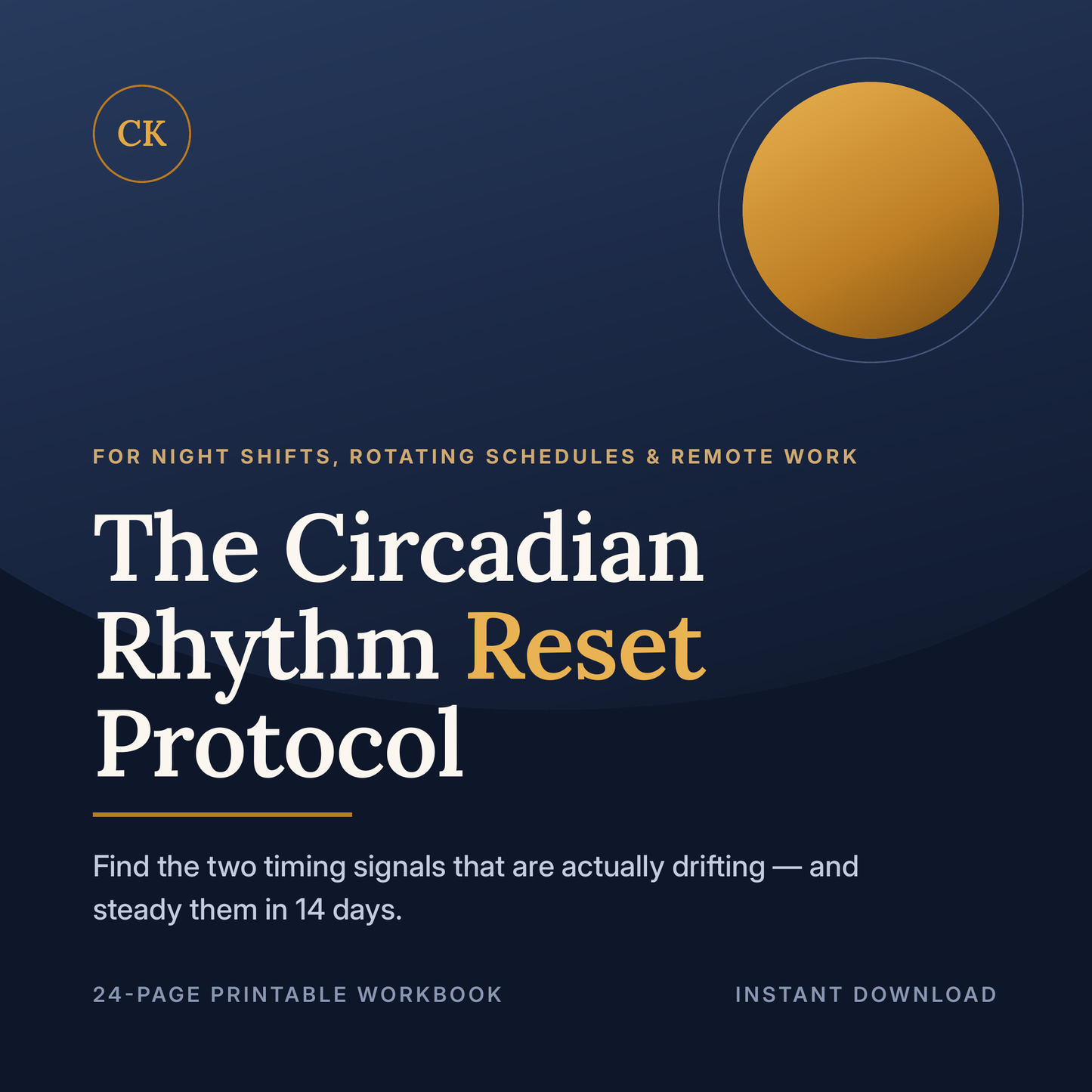
The Circadian Rhythm Reset Protocol
Couldn't load pickup availability
The Circadian Rhythm Reset Protocol
A practical guide for people who don't work normal hours.
Most sleep advice assumes you finish work at six, eat dinner at seven, and get into a dark bedroom by eleven. If you're on nights, on a rotating schedule, or working from a room where the workday never quite ends, that advice doesn't fail you because you lack discipline. It fails because it was written for a life you don't live.
This 24-page guide takes a different approach. Instead of a routine to follow perfectly, it helps you find the two timing signals — out of five — that are actually drifting in your week, and stabilize those.
How it works
You start with a seven-day audit. No changes yet, just an honest record of when you sleep, when light reaches your eyes, when you eat, and when your energy drops. Most people find the answer on that page: one cue is swinging by three hours and dragging everything with it.
From there you pick a protocol built for your situation:
- Protocol A — Remote work. Rebuild the opening and closing edges a commute used to provide, with three worked examples for earlier, conventional, and later chronotypes.
- Protocol B — Permanent nights. Support alertness during the shift and defend daytime recovery afterward, with separate sample maps for 8-hour and 12-hour shifts.
- Protocol C — Rotating schedules. Decide deliberately between full adaptation, partial adaptation, and treating a night as an isolated event — plus a transition planner for the days between blocks.
Then you run a 14-day experiment with day-by-day trackers, change one variable at a time, and finish with a one-page rhythm plan in your own handwriting.
What's inside
- Seven-day rhythm audit with a pattern-reading worksheet
- Three schedule-specific protocols with fill-in planners
- Support chapters on meal timing, light planning, caffeine, naps, movement, and sleep environment
- 14-day experiment structure with Days 1–7 and 8–14 trackers
- Fragmented-sleep troubleshooting table
- A real-life barriers page for caregiving, shared housing, fixed breaks, and unpredictable overtime
- One-page personal rhythm plan
- "When routine changes are not enough" — what to bring to a clinician and what to ask
- Sourced from NIOSH and NHLBI guidance, with every link verified
A note on what this is
This is education and structure, not treatment. It won't diagnose insomnia, shift work disorder, or sleep apnea, and it says so plainly — including a page on the symptoms that mean you should stop optimizing and get evaluated and written by a registered nurse who has worked the schedules in question.
Format: 24-page PDF, letter size, print-friendly worksheets. Instant download.
-
Instant download
Your file is available the moment payment clears — on screen and by email.
-
Read on any device, or print it
A standard PDF. Opens on phone, tablet, laptop or e-reader. Print it if you prefer paper.
-
A real person can help
Trouble with a download? Email us with your order number and we'll sort it.